Wait — take 15% off your first order.
Join the First Look Club and see new designs before anyone else.

I was a 1970s kid, which means I grew up surrounded by hippie culture without being nearly old enough to take part in it. I watched the older kids with their long hair, flowing skirts, and sandals and thought… awesome.
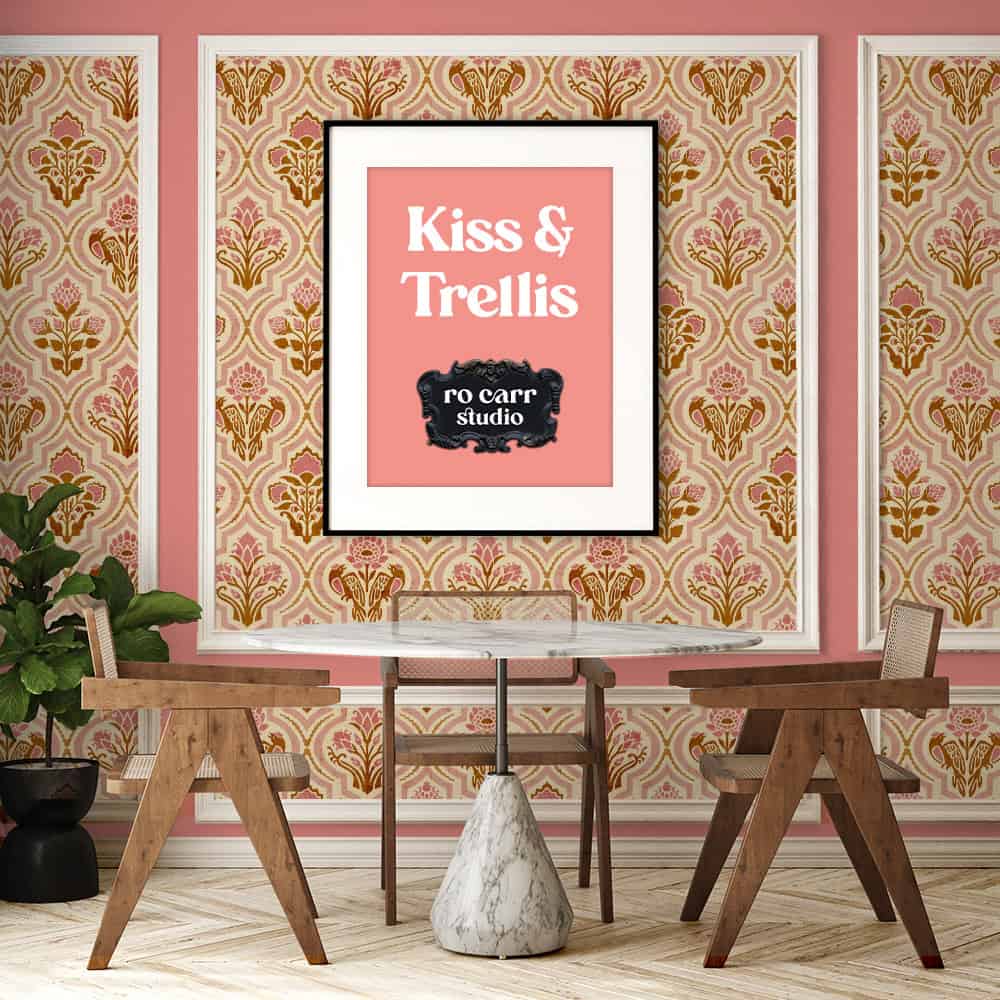
My turn to try out these styles came in college, when I skipped between art student attire and hippie chick style (now we’d call it boho). Long, flowing hair, check. Doc Martens, check. A couple of lucky-find vintage dresses, check. One in particular I wore until it was threadbare: a true hippie dress, lightweight cotton, loose fit, ankle-length, bell sleeves, tasseled strings dangling from the neckline, and a mix of block-printed fabrics in an earthy palette of soft beige, peach and brown. A genuine vintage piece, in a style that was everywhere in the ’70s and still turned up now and then in the thrift stores I haunted. The colors of that dress were not far off from the palette I landed on for Kiss & Trellis. How ’bout that? Some loves just wait for you.
Most of those dresses, it turns out, owed a debt to India. In the late 1960s and into the ’70s, Indian clothing swept the West: block-printed cottons, flowing kaftans, paisley everywhere. The hippie look I admired from the sidelines was, in large part, Indian textiles on American kids. And the tradition behind them is very, very old.
Block printing works pretty much the way it sounds. An artisan carves a design into a wooden block, inks it with dye, and presses it onto cloth by hand, again and again, lining each impression up with the last. Every color gets its own block. Families of printers have passed the craft down for generations, and the work still goes on today.
How old is it? In the 1920s, fragments of Indian block-printed cotton turned up in Fustat, Old Cairo, a long way from home. Some have been dated to the 13th and 14th centuries, and they’re thought to have been everyday cloth rather than luxury goods. Even that long ago, Indian cotton prints were traveling the world.
Part of what made them so prized was color. Cotton is notoriously hard to dye, and Indian dyers mastered natural dyes that came out vivid and stayed put. Centuries later, when printed Indian cottons reached Europe, they were so popular that both England and France passed laws banning them to protect their own textile industries. It didn’t work. People wanted the cloth anyway. I can relate.
Kiss & Trellis is my entry in Spoonflower’s Sweet Motifs challenge: a lattice filled with hand-drawn motifs of paired birds, thistles, lotus, and little daisy-like florals.
Now, “sweet” makes me a little nervous. I don’t typically do cute. Left to its own devices, a sweet motif challenge can drift toward cupcakes and bunnies, and I’d rather drift toward something with some history and a little mischief. Block print gave me both.
If you know my work, you may have noticed I tend toward tightly packed thematic designs full of details. The design world calls that maximalism. I call it – I can’t help myself. This challenge, Sweet Motifs, was the exact opposite of what I do naturally. The prompt called for designs that hold up even when printed very small – 1″ in size. So, with misplaced confidence, I started down the path of creating a series of super simple motifs. I rolled right along with the first draft, then looked at it miniaturized and could see I’d put too much in. A couple drafts later, simplifying with each round, I finally ended up with the design I entered. Probably still more detail than called for, but I really love how it turned out. And for those who choose to buy larger scales, there’s still plenty there to keep it interesting. I layered in scratches and scuffs typical of hand printing, plus a soft kraft paper texture under everything.
Love it up close, muddled at one inch.

The final entry, after a few rounds of taking things out. I surely could do more reducing, but decided to meet in the middle.

I’ve always been curious about the world: other cultures, languages, places. Curious enough to make a formal study of the history of world art and architecture, which is a fancy way of saying I dig this stuff. It all finds its way into my work, whether I mean it to or not.
It shows up in my closet and my living room, too: flowy boho garments, a carved Moroccan footstool, an oversized painted African drum that serves as a side table.Nothing matches, and there’s always room for more. Maximalism, again. I really can’t help myself.
I don’t claim any expertise in these traditions. I’m an admirer, a borrower of inspiration, and a lifelong student. Kiss & Trellis is my love letter to the block printers, past and present, whose work has followed me from a thrift-store dress to my drawing table. England and France once tried to ban this stuff. I’d like to see them try with me.