
Wait — take 15% off your first order.
Join the First Look Club and see new designs before anyone else.

There’s an old saying in Japan: The crane lives a thousand years; the turtle, ten thousand. People say it at weddings and milestone birthdays as a wish for a long, happy life. Real cranes manage more like twenty or thirty years in the wild, which is still pretty respectable for a bird that spends much of its time standing on one leg in cold water. The turtle will have to wait for another design. This one belongs to the crane.
Thousand Year Crane is my entry in Spoonflower’s Vintage Stripes challenge: whooping cranes stepping through columns of bamboo, divided by navy bands of scalloped Japanese waves, with a little pink tucked into the scallops and the cranes’ crowns. It’s a stripe, technically. I just couldn’t leave it at that.
I don’t often make a stripe the star of my designs. Stripes usually play a supporting role in my collections, the dependable coordinate that makes everything else look good. So as a hero, this one is a bit of an outlier for me. But look closer and it’s still me through and through: maximalist, botanical, and uber birdy. I just lined everything up in rows this time. Creating it was one thing, but seeing how it looked in my mockups was another, particularly on the garments. Stripes are very unforgiving! I feel for the sewists and makers in this world!
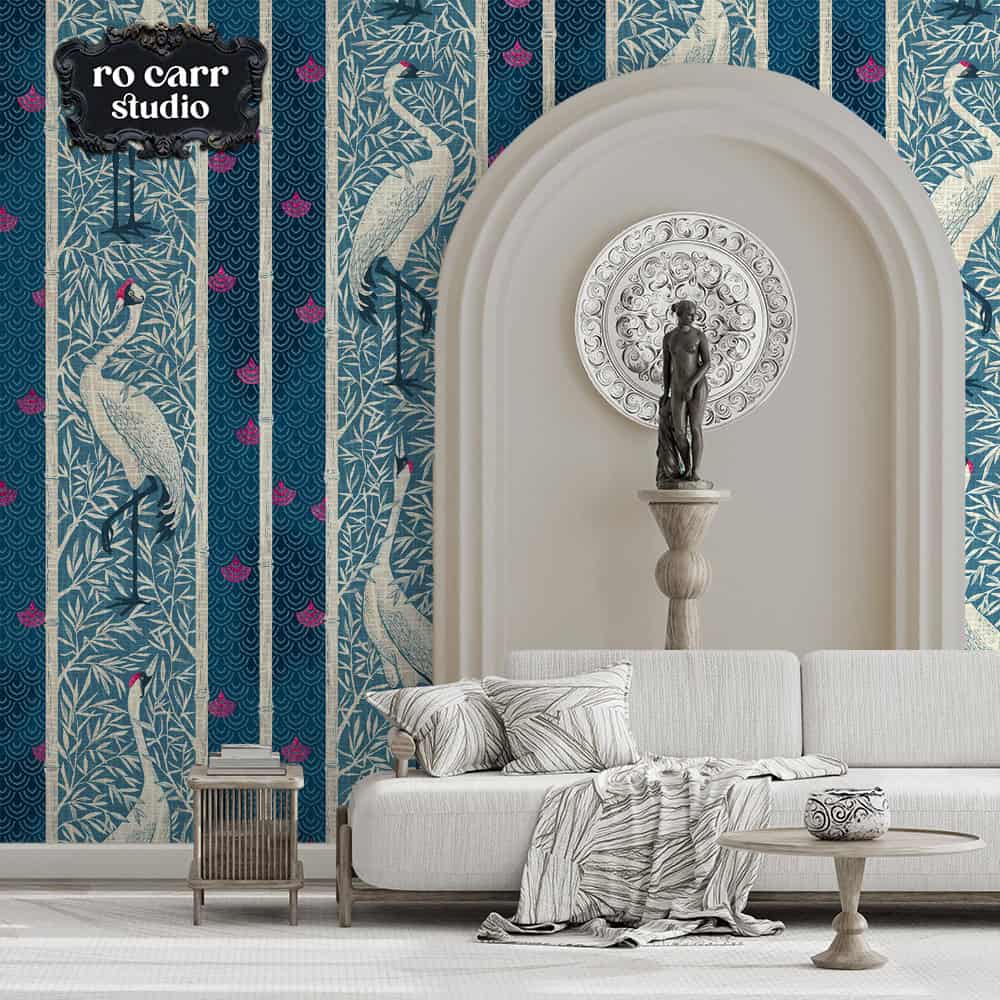
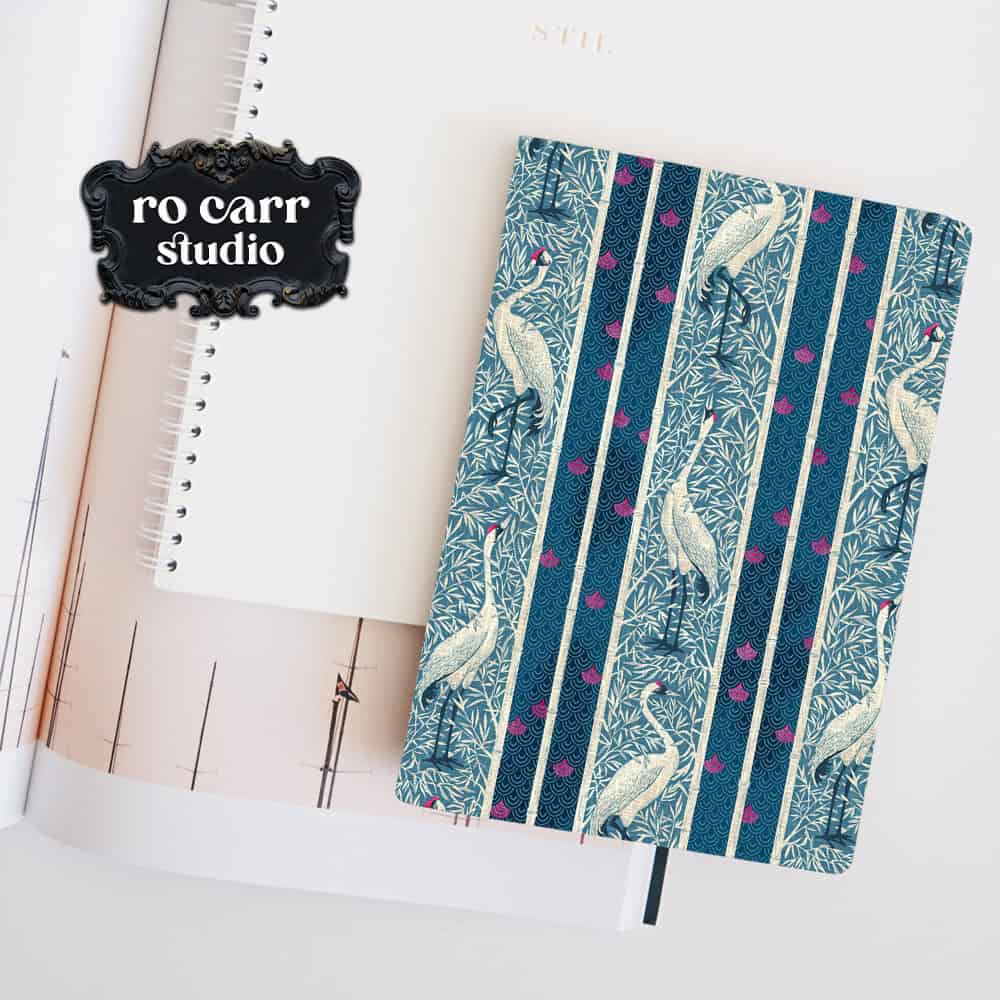

Almost everything in this design comes from traditions that were centuries old before anyone thought to put them on a pillow.
The waves. That scalloped wave pattern, made of overlapping arcs, stands for the waves of the open sea. Its Japanese name comes from an ancient court dance whose dancers wore costumes covered in the pattern. The pattern is said to symbolize tranquility and quiet strength. I’ve been accused of neither, but I can draw it.
The bamboo. In Chinese art, bamboo, pine, and plum are known as the Three Friends of Winter, because they stay green when everything else gives up for the season. Bamboo bends in a storm without breaking, so it became a symbol of getting through hard times with your integrity intact. Painters have spent entire careers trying to capture a single stalk in ink. I make no claims of joining them. But bamboo sure makes a nice stripe all by itself.
The cranes. Across China and Japan, the crane has long meant longevity and good fortune, showing up on wedding kimono, lacquerware, and celebration sweets. It’s also why people fold a thousand paper cranes as a wish for someone’s long life or recovery.
The challenge asked for vintage, and this design has layers of it. The scalloped wave and its fellow Japanese patterns have been around for more than a thousand years. The Three Friends of Winter were a favorite of Song dynasty painters in China for about as long. Then, in the second half of the 1800s, these very motifs sailed west. When Japanese prints, lacquer, and textiles started arriving in Europe and America, designers went wild for them, and Victorian parlors filled up with Aesthetic Movement wallpapers featuring cranes, bamboo, fans, and waves. One English designer even published a bamboo wallpaper in 1872. So this design has two kinds of vintage built in: the old traditions themselves, and the era when the West first fell head over heels for them. If you haven’t seen Topsy-Turvy, Mike Leigh’s ode to Gilbert and Sullivan, go see it and you’ll understand what I mean.
So! A vintage stripe shouldn’t look like it just came off the press, so I added a faded effect to the pink scallops, the cranes’ caps, and the background color. I also added two different textures with weathered aspects of their own: a felted texture layered with hand-drawn linen lines. I wanted it to feel like a length of fabric someone’s grandmother tucked away in a cedar chest, then rediscovered decades later, a little softer and a little faded, but no less lovely.
The crane of Japanese art is the red-crowned crane: snowy white, black trim, and a bright red cap. Mine are whooping cranes, their North American cousins. Don’t feel bad if you couldn’t tell – they wear nearly the same outfit. So in this design, a bird from my side of the world wanders into a very old tradition from the other side.
So why whoopers? They weren’t just a pretty choice. Putting them in this design is my small way of cheering on the people working so hard to save them from extinction. A thousand years is a wish for a long life, and whooping cranes very nearly didn’t get one. In the 1940s, only about 21 were left in the wild. Thanks to decades of conservation work, the main wild flock that winters on the Texas coast now numbers around 540, and a second, eintroduced flock of a few dozen has been summering right here in Wisconsin since 2001. They’re still endangered, so a thousand years seemed like the right thing to wish them.
I have not yet seen a whooping crane, not for lack of trying.
The hubs and I go to Horicon Marsh a couple of times a year. Horicon is one of the places Wisconsin’s whooping cranes call home. Young cranes are released there. People see them there all the time. Other people, anyway. We’ve not been lucky yet, but we’ll keep trying!
A year ago, the hubs and I were at our favorite little boat launch on the Kalamazoo River in western Michigan, smack in the middle of a sandhill crane migration. If you’ve never heard sandhills in a crowd, picture several hundred middle schoolers blowing bugles all at once. Glorious and deafening. Then, somewhere in all that racket, came a completely different call. It sounded kind of “whoopy,” whatever that means. We looked at each other. Could it be? I looked it up, and it matched! Ever the conscientious birder, I added it to my life list in the Merlin app (free, super awesome, and from the Cornell Lab of Ornithology).
A few days later, a very polite email arrived from someone at the Cornell Lab, gently explaining that, given when and where, a whooping crane was highly unlikely. Disabused. Kindly, but thoroughly. In fairness, we only heard the bird and never saw it. I’ve since learned that sandhills can make all kinds of noises, and that whoopers are waaaay bigger. A giant white bird in a flock of sandhills would be hard to miss, even squinting into the sun.
Then, just this month, a whooping crane family turned up in LaSalle County, Illinois: a pair with this year’s youngster in tow (a baby crane is called a colt, which I find delightful), traveling south with a crowd of migrating sandhills. That’s a couple of hours down the road, which by birder standards is practically next door. They’re part of the reintroduced eastern flock, the birds that summer in Wisconsin and are carefully tracked by the people working to bring the species back. Did I see them? I did not.
So for now, the only whooping cranes I’ve seen up close are the ones I drew. If the saying is right, I’ve got time. I’ll keep my binoculars handy and my ears open for a call that doesn’t sound like a sandhill. And if you see one before I do, please don’t tell me. Actually, do. Then tell me exactly where.